Growing up, my closest friends were the kids nobody else was paying attention to yet
A Swiss-Greek girl, a Russian boy, and an expat from Saudi Arabia. At age 10, we would sneak out to the Burnside skate park at 6am before skating was cool, and in the afternoons hunted second hand at the goodwill bins with our allowance before vintage had a name. I spent most of my time in neighborhoods that didn't look like me but felt more like home than anywhere else.
That instinct, toward what's forming, not what's already arrived, has shaped everything since. It's why I ended up in design school over a sorority, in high fashion before streetwear crossed over, in MLS before American soccer was taken seriously, in Hong Kong before the industry understood what Asia was becoming.
I spent most of my career working or embedded in Asia, and it never felt foreign. It felt like the most concentrated version of something I already understood. Communities building their own aesthetic codes, products carrying meaning no marketing budget can manufacture, brands winning because they belong rather than because they're loud.
APLA isn't a geography to me. It's a conversation I've been in for a long time.
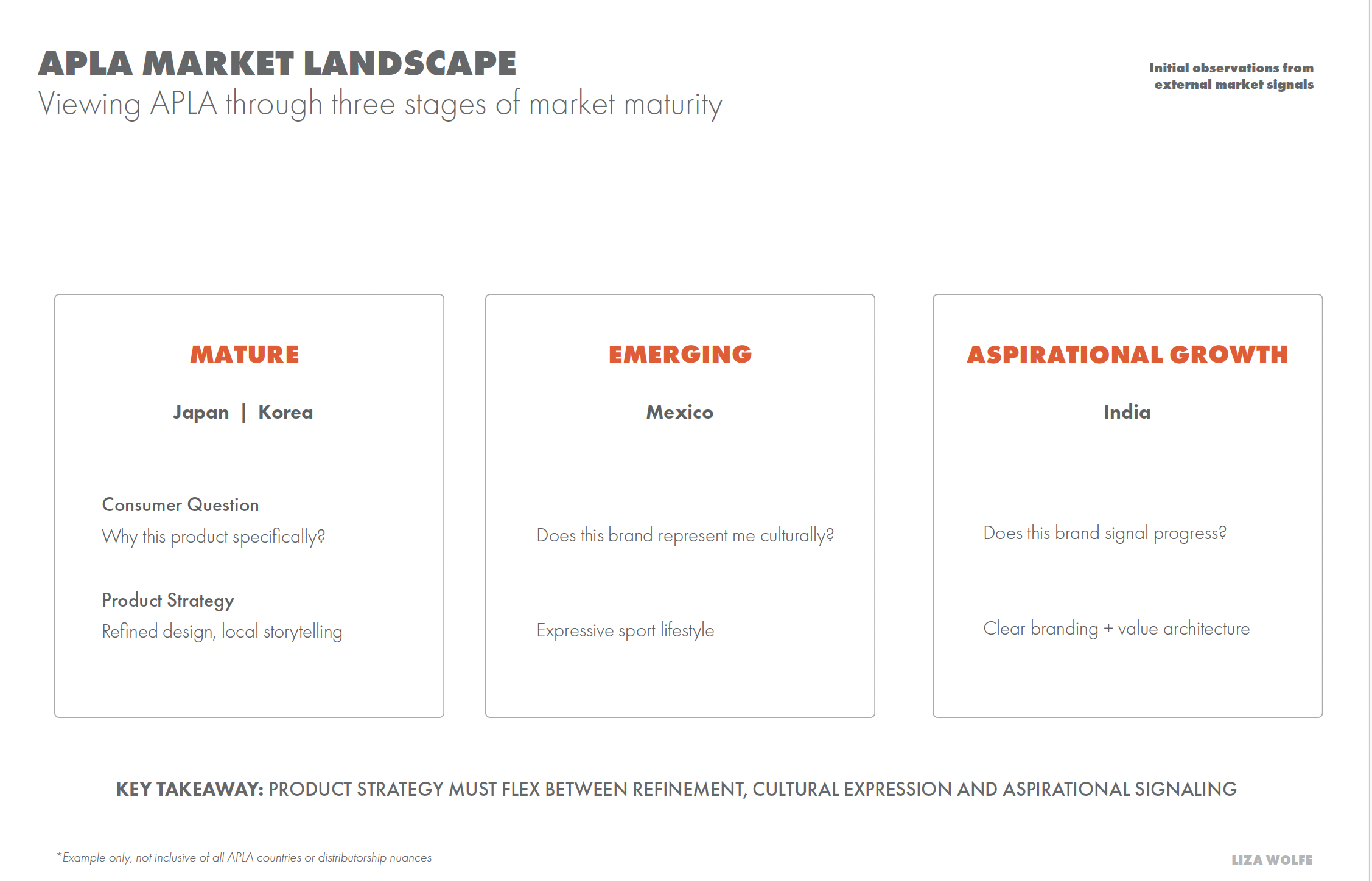
THE FRAMEWORK
APLA isn't one market.
It's three different consumer relationships at three different stages of maturity.
Most global strategies treat APLA as a single brief. It isn't. Japan, Korea, Mexico, and India share a geography label and almost nothing else.
The consumer question in Japan is why this product specifically? Refinement, local resonance, earned trust.
In Korea it's does this brand represent me culturally right now? Speed, specificity, the right moment.
In Mexico and India it's does this brand signal where I'm going? Aspiration, clear identity, accessible entry.
Product strategy has to flex across all three simultaneously. That's not a complexity to manage around. That's the whole job.
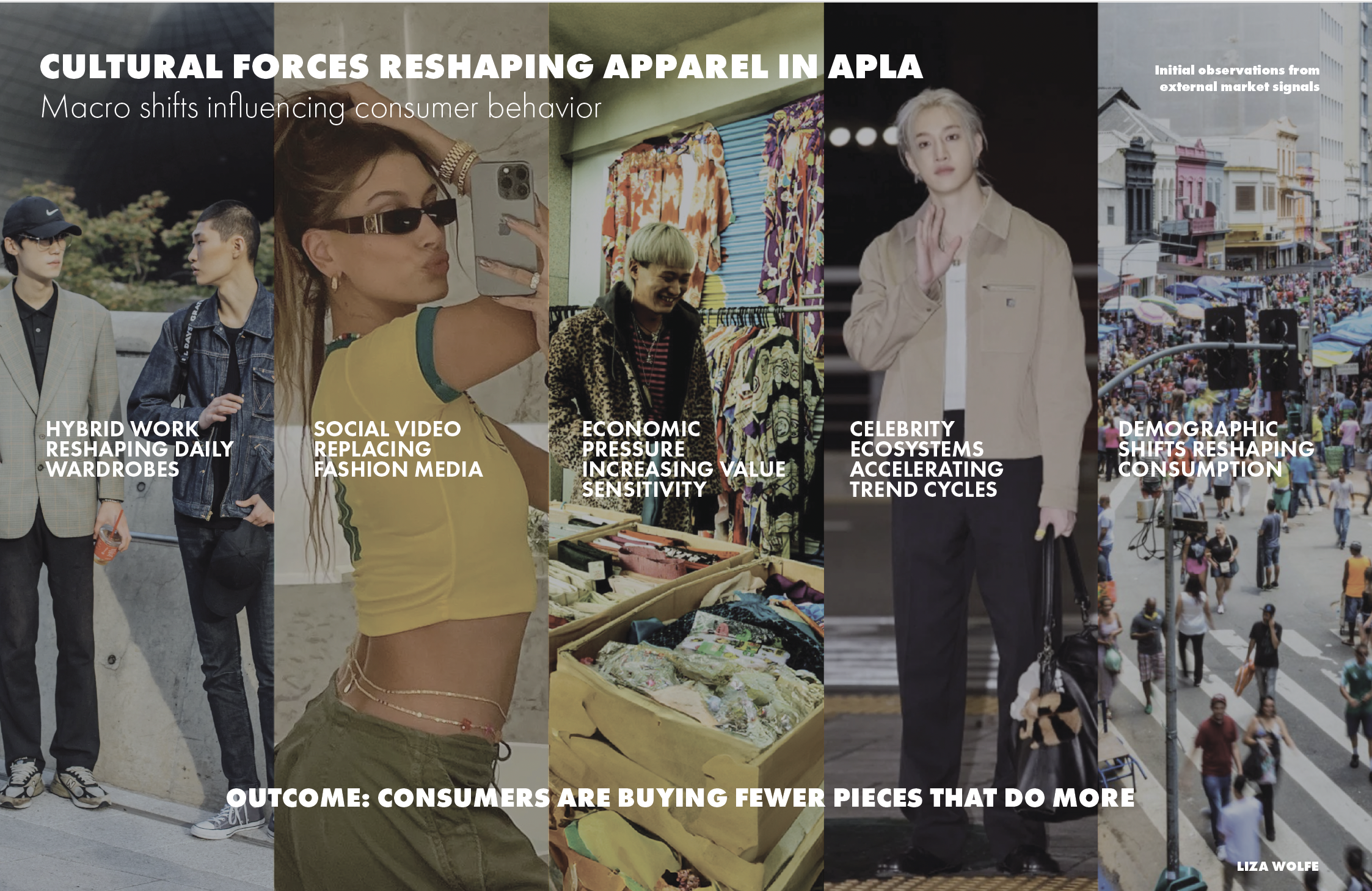
Five forces are reshaping how APLA consumers relate to product. The outcome is the same across all of them.
Hybrid work collapsed the wardrobe. Social video replaced fashion media and compressed trend cycles from seasons to weeks. Economic pressure increased value sensitivity across every market. Celebrity ecosystems - K-pop, regional influencers, the Lisa effect - accelerated cultural adoption in ways that brands are still learning to respond to. Rapid urbanization is reshaping who the consumer is becoming.
The outcome isn't complicated: consumers across APLA are buying fewer pieces that do more. Product that can't justify its place in a smaller, more intentional wardrobe doesn't get bought. That's not a trend. That's a structural shift.
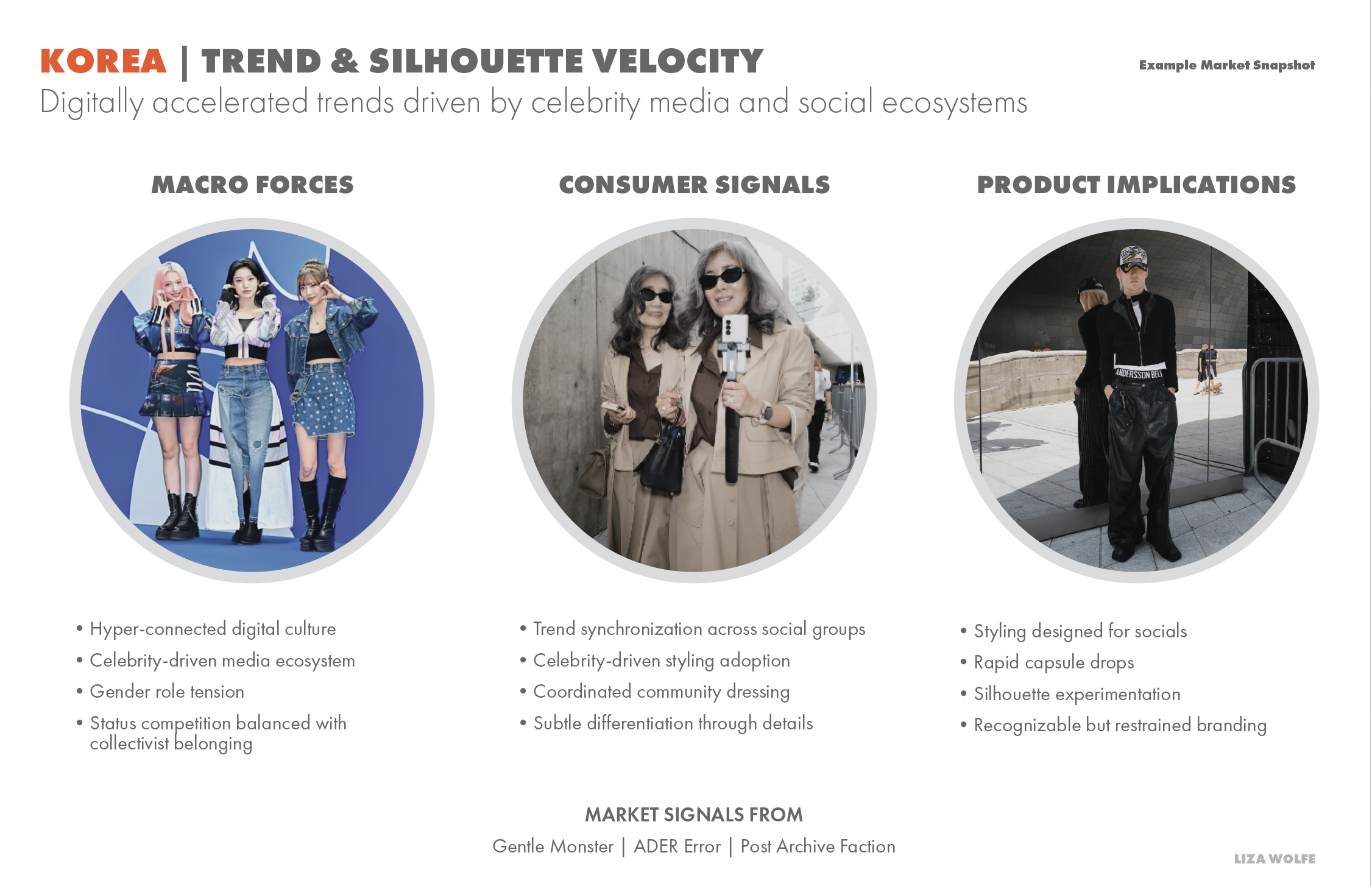
In Korea, brand success is earned through timing, specificity, and cultural precision. Not awareness.
Korea has moved from aspirational global alignment to cultural confidence and local identity assertion faster than almost any other market. The consumer isn't looking to global brands for permission anymore. They're looking for brands that understand the moment they're in - which neighborhood, which stylist, which silhouette detail, which week.
Gentle Monster understood this before most. Their retail spaces aren't stores - they're cultural installations where the product becomes a souvenir of the experience. Post Archive Faction understood it differently - conceptual silhouettes, underground references, the kind of detail that rewards the consumer who already knows. ADER Error sits somewhere between the two. What all three share is cultural specificity over cultural aspiration.
For global brands, the implication is clear: speed without curation is just noise. Getting into the moment before the trend cycles out requires people on the ground, relationships that predate the brief, and the organizational infrastructure to move when the signal arrives - not six months later.
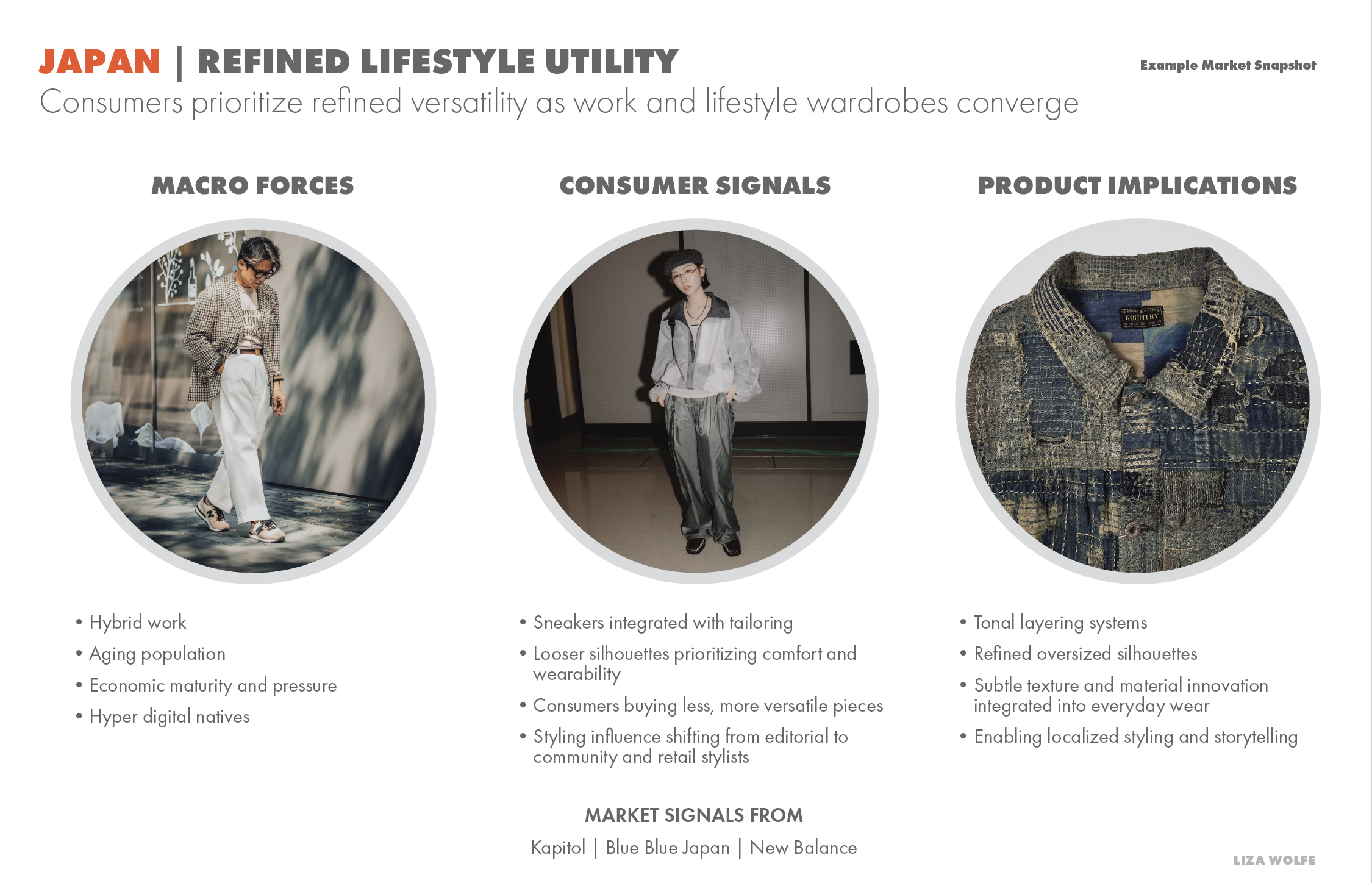
In Japan, the brands winning aren't the loudest ones. They're the ones that feel local without trying to.
Japan has shifted from dominant global messaging to humility, refinement, and local resonance. Editorial influence has given way to community and retail stylist culture - the local shop with its own lookbook, the stylist who recontextualizes a global silhouette for a specific neighborhood. Brand success is now emotional positioning, not awareness.
New Balance is the clearest case study. An American brand perceived as a local brand in Japan - not because the product is dramatically different, but because they embedded themselves with the right people, in the right spaces, before the market arrived. Kapitol and Blue Blue Japan tell the same story from the Japanese side: heritage reinterpretation, material craft as table stakes, branding that rewards attention rather than demanding it.
The aging population, hybrid work wardrobes, and hyper-digital native generation are all pulling in the same direction: looser silhouettes, tonal layering, refined versatility. Product that makes itself useful in multiple contexts without announcing itself in any of them.
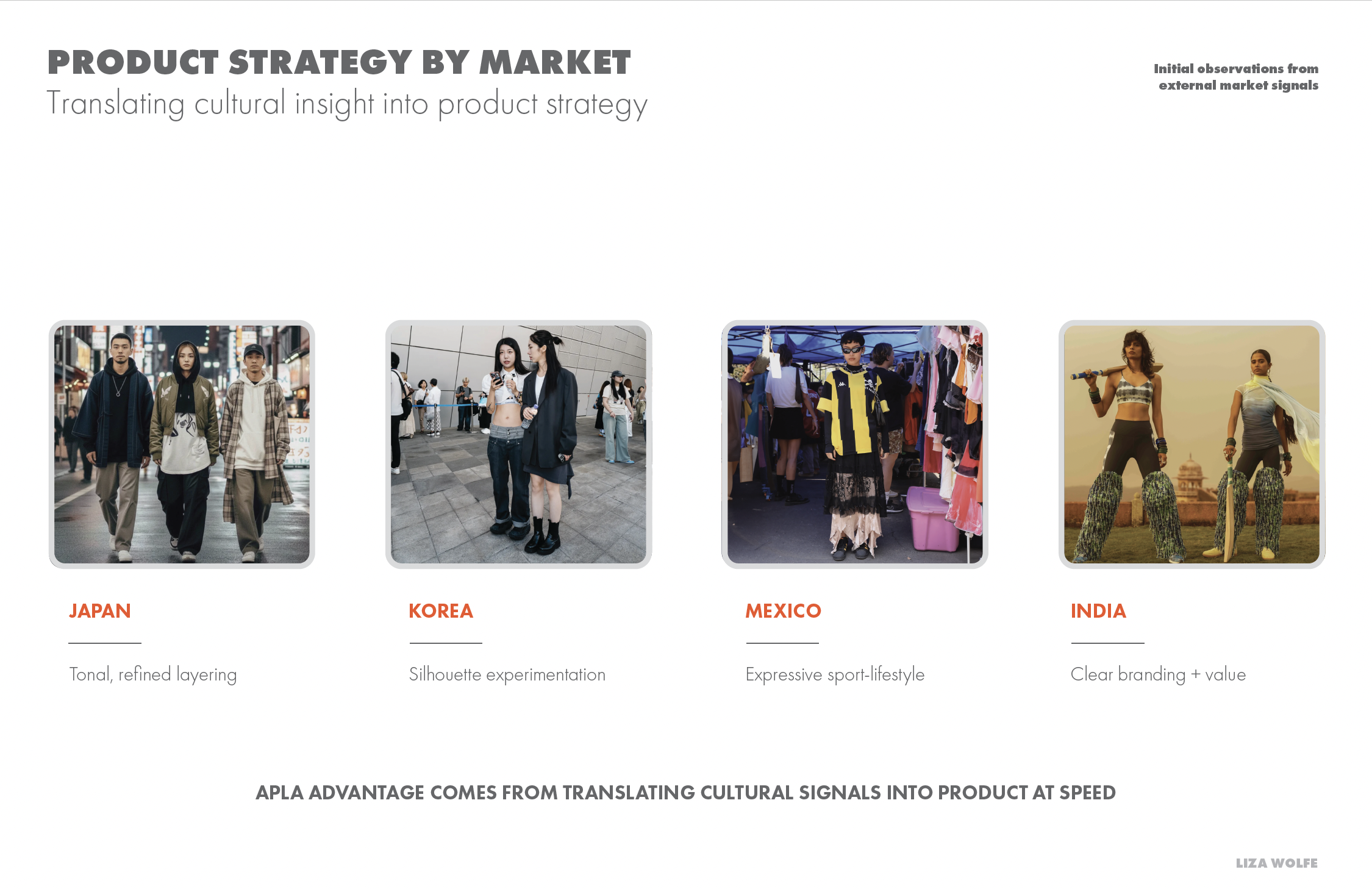
The APLA advantage comes from translating cultural signals into product at speed. Not from applying one global brief across different markets.
Japan needs tonal refined layering that enables localized styling. Korea needs silhouette experimentation with rapid capsule drops and restrained branding. Mexico needs expressive sport-lifestyle with clear identity and cultural resonance. India needs aspirational clarity - strong brand signals and value architecture that meets a first-generation global consumer where they are.
These aren't just aesthetic differences. They're fundamentally different product briefs, different creation timelines, different distribution logics. The brands winning across APLA aren't the ones with the biggest global strategy. They're the ones specific enough to feel made for someone.