Strategic Case Study
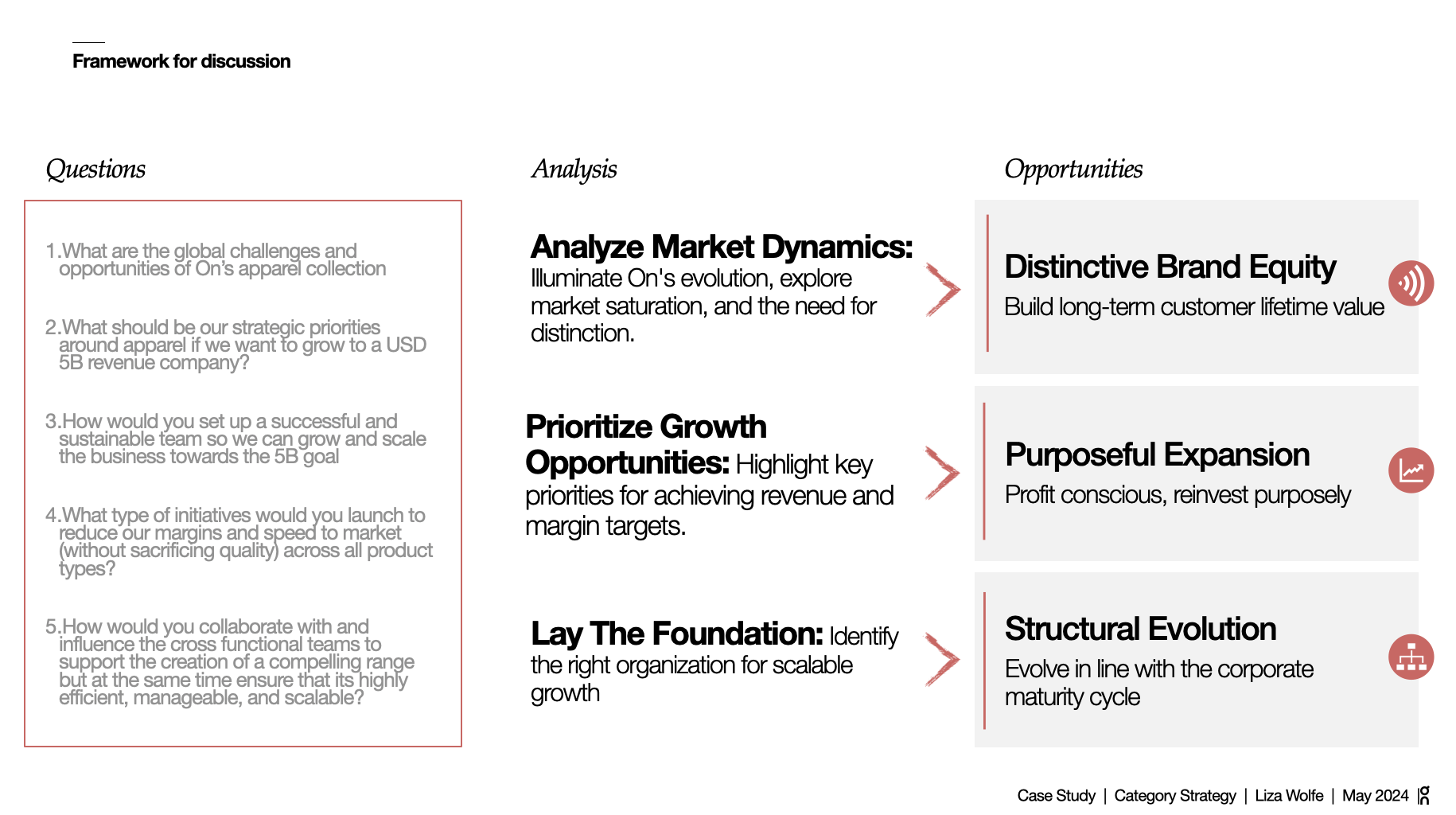
I built this to answer five questions On asked about scaling to $5B.
On asked five questions about scaling to $5B through Apparel. This is the framework I built to answer them, covering market dynamics, competitive positioning, brand architecture, organizational design, and growth sequencing. The work reflects how I think about category strategy: start with what the market is telling you, identify where the brand has permission to grow, and build the infrastructure that makes scaling possible without losing what made the brand worth scaling in the first place.
THE FRAMEWORK
I organized the brief into three strategic questions before answering any of them
Most category strategy work jumps straight to recommendations. I start by asking whether we're solving the right problem. The brief had five questions. I collapsed them into three: what does the market require, where should we grow, and what does the org need to become. That sequencing matters. You can't set growth priorities without understanding market dynamics. You can't design the org without knowing what the growth strategy demands of it.
MARKET DYNAMICS
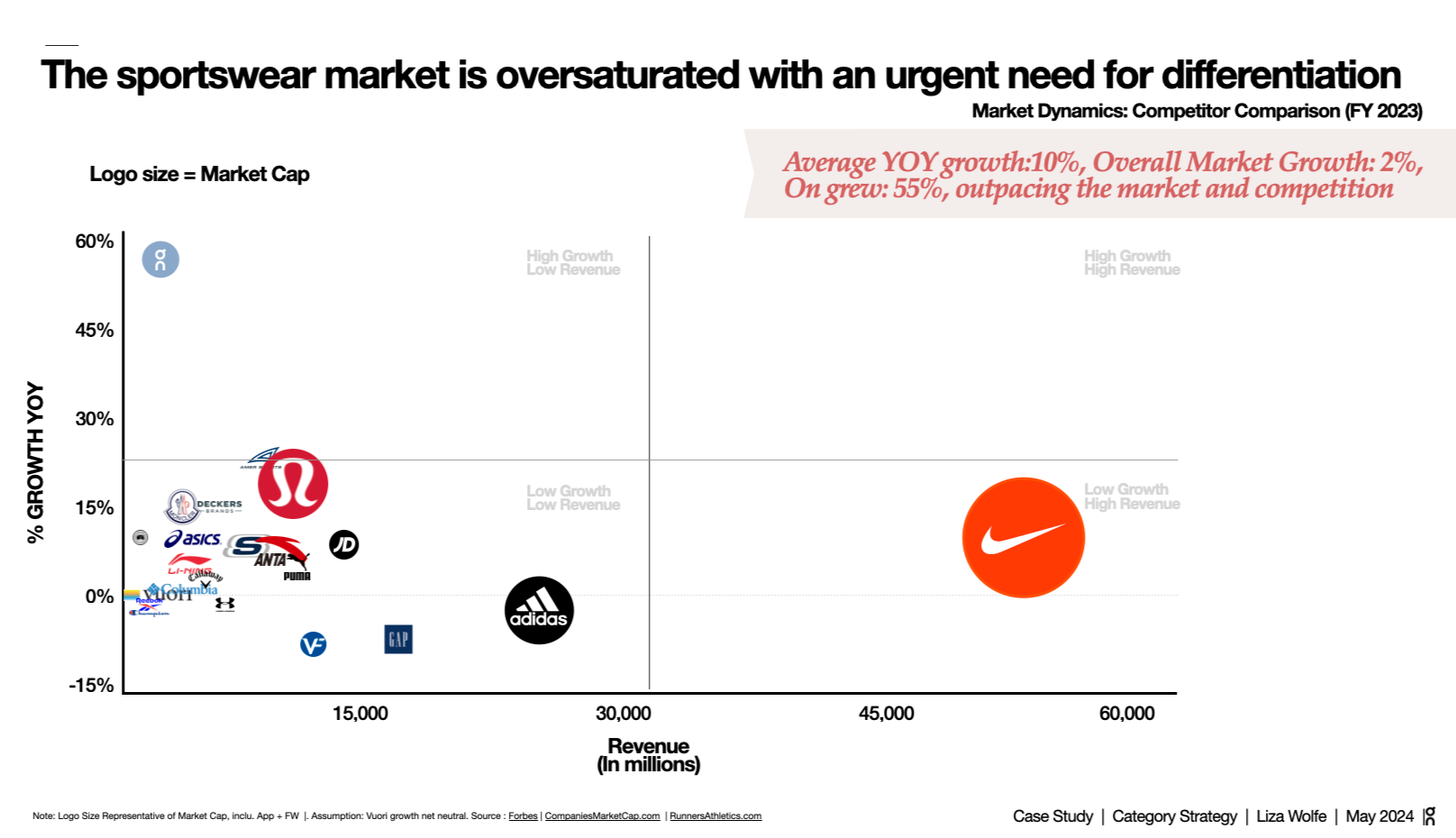
On is the fastest-growing brand in a saturated market. The opportunity is to make sure that growth means something in apparel.
The sportswear market grew 2% overall in FY2023. On grew 55%. That gap is the result of a decade of disciplined brand building, visible innovation, and a distribution strategy that protected premium perception while others chased volume. The apparel opportunity sits inside that momentum, but it isn't automatic.
On currently holds an estimated 0.04% share of a $199B global athletic apparel market projected to reach $308B by 2032. The brands with the largest apparel share built it through franchise excellence, material innovation, and category authentication over years. The market is there. The question is how On earns its place in it on its own terms.
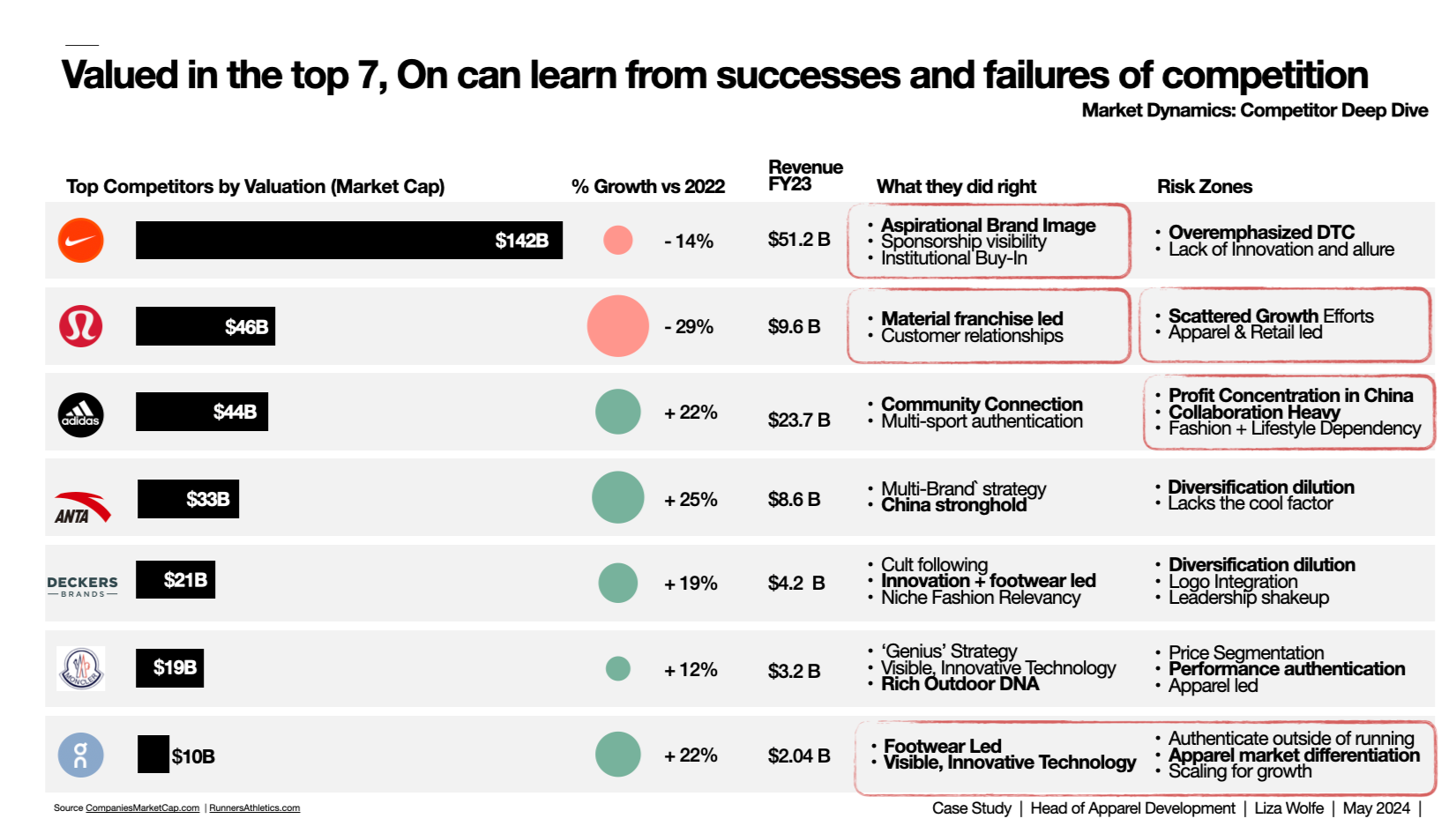
The market tells a clear story about what works and what doesn't.
On's risk zones are specific and solvable.
The brands gaining ground share a common thread: disciplined focus on a core identity while competitors fragmented. On's risk zones are not brand problems. They're execution problems, authenticate outside of running, differentiate in apparel, scale without losing what makes the brand worth scaling. Each is solvable with the right foundation.
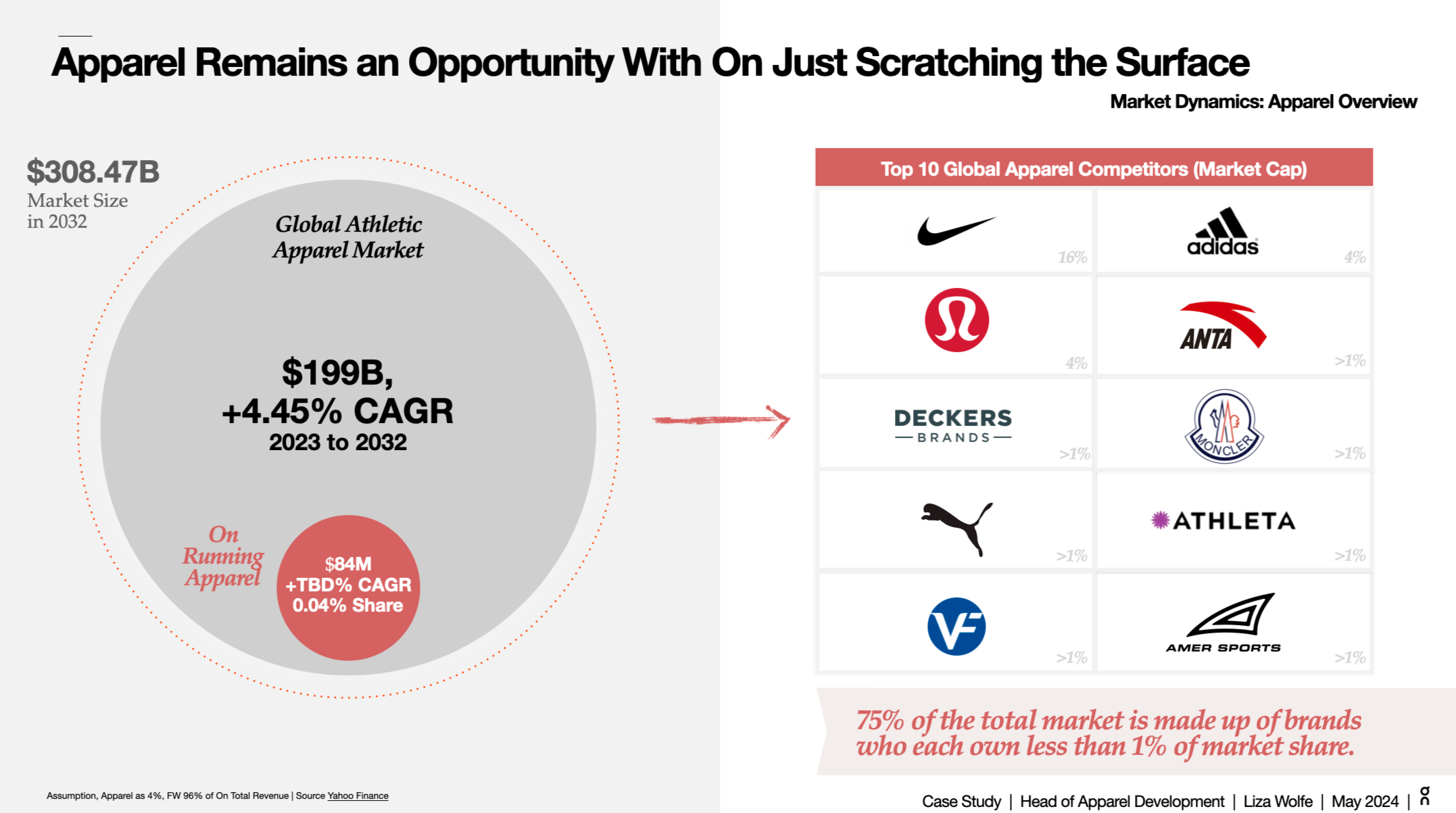
On holds 0.04% of a $199B market projected to reach $308B by 2032. The opportunity isn't whether to be in apparel. It's how to earn the right place in it.
The brands with meaningful apparel share built it over years through franchise excellence, material innovation, and category authentication. On has the brand momentum no competitor at this stage of growth has had. The window to convert that momentum into apparel market share, before the business scales past the point where foundational decisions are easy to make, is now.
Brand POSitION
The strengths are real. The weaknesses are structural, not brand-level. That distinction matters for how you fix them.
On's competitive advantages are defensible: footwear authentication, visible recognizable innovation, premium perception, a genuine sustainability commitment, and localized community engagement that larger brands struggle to replicate at scale.
The weaknesses aren't about the brand itself. Apparel is organizationally in its infancy. Expansion risks diverting focus from the core business. Customer awareness in apparel is low. The threats that matter most aren't external competitors, they're internal: silos forming as the business scales faster than its processes, potential brand dilution from moving into new categories before existing ones are fully owned, quality control eroding when speed is prioritized without structure.
The implication is clear. Fix the internal foundation before accelerating the external range.
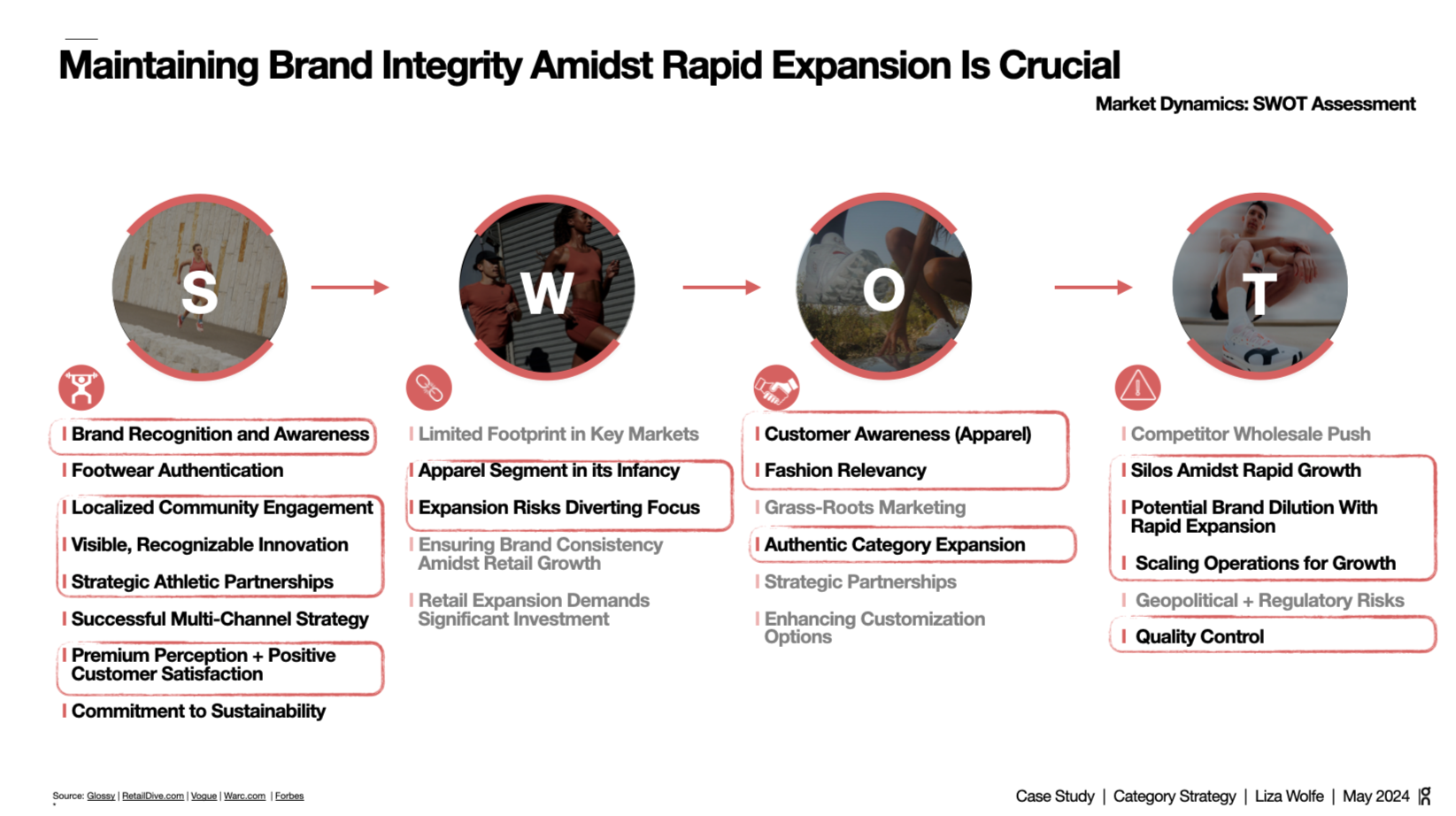
Market Saturation & Intense Competition Call for Strategic Foresight
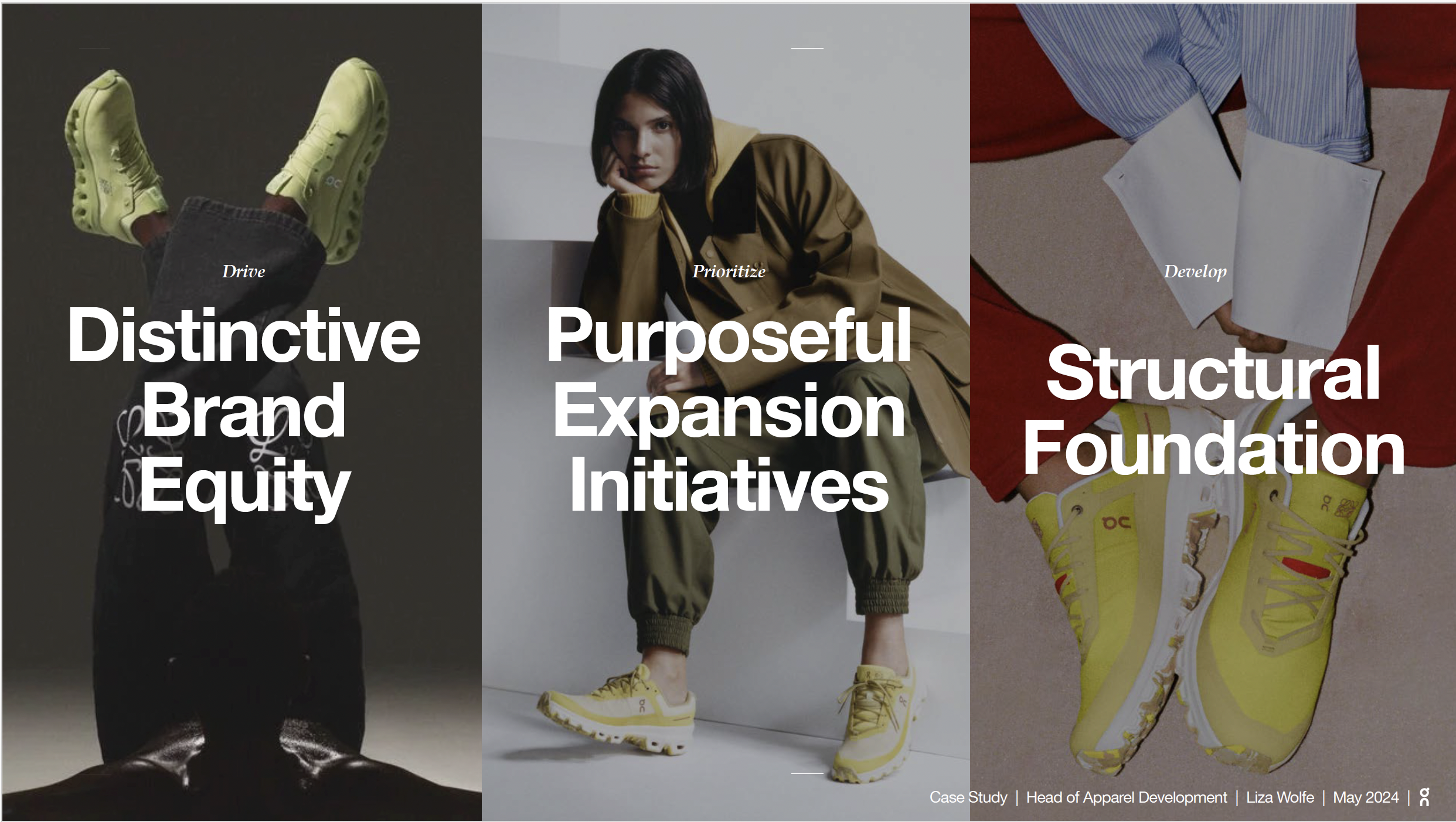
Brand Architecture
On has brand salience in footwear. In apparel, it's starting from zero. Those require completely different strategies.
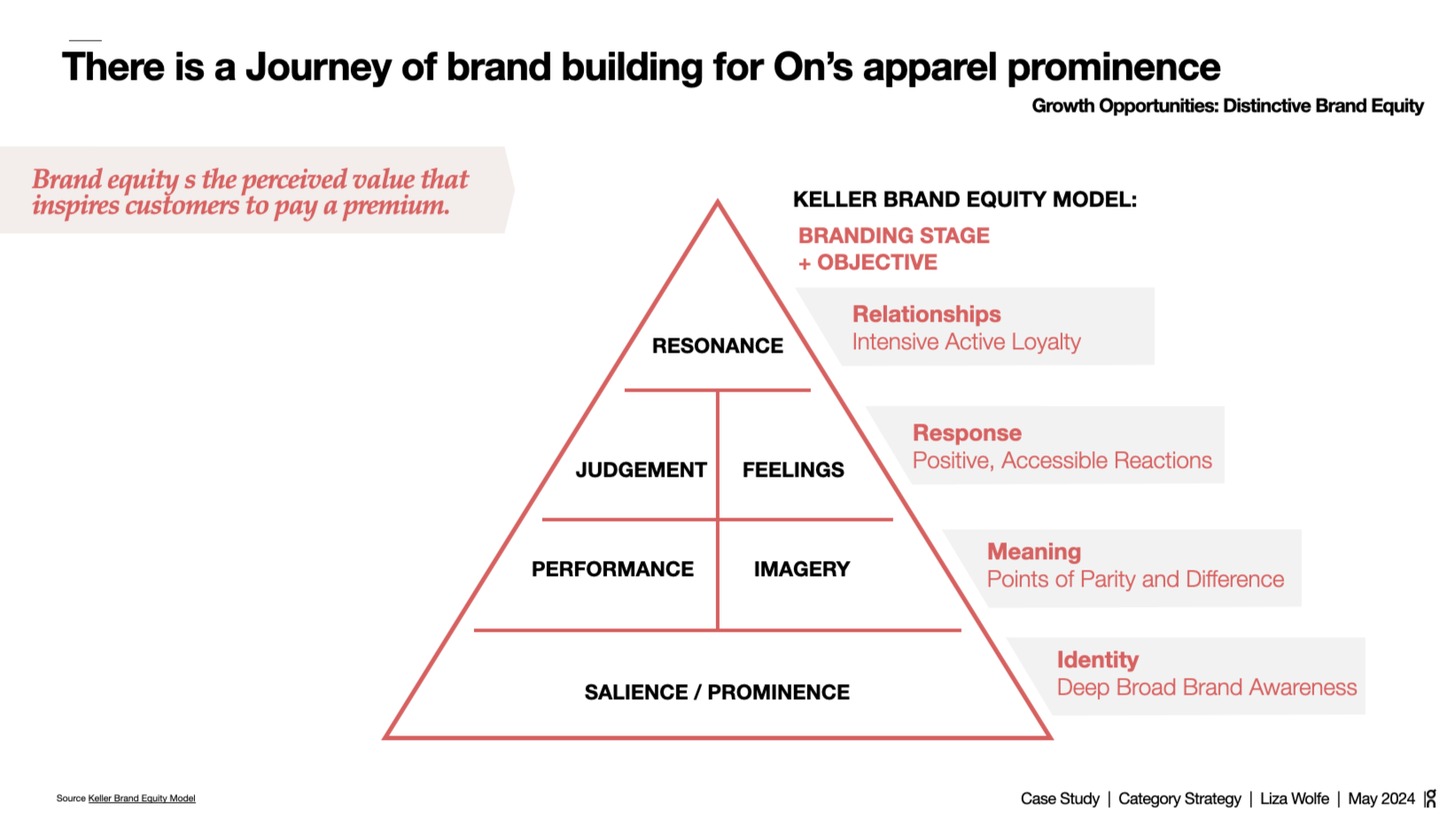
Brand equity isn't transferable between categories automatically. The Keller model makes this visible: salience, performance, imagery, judgment, feelings, resonance are a sequence, not a menu.
On's apparel business is at the identity stage: building deep, broad awareness from scratch with a consumer who already knows the footwear brand but hasn't been given a reason to consider the apparel. The strategic implication is that apparel needs its own brand-building investment, its own franchise anchors, its own performance credibility, its own emotional associations. Leveraging footwear equity gets you in the door. It doesn't close the sale.
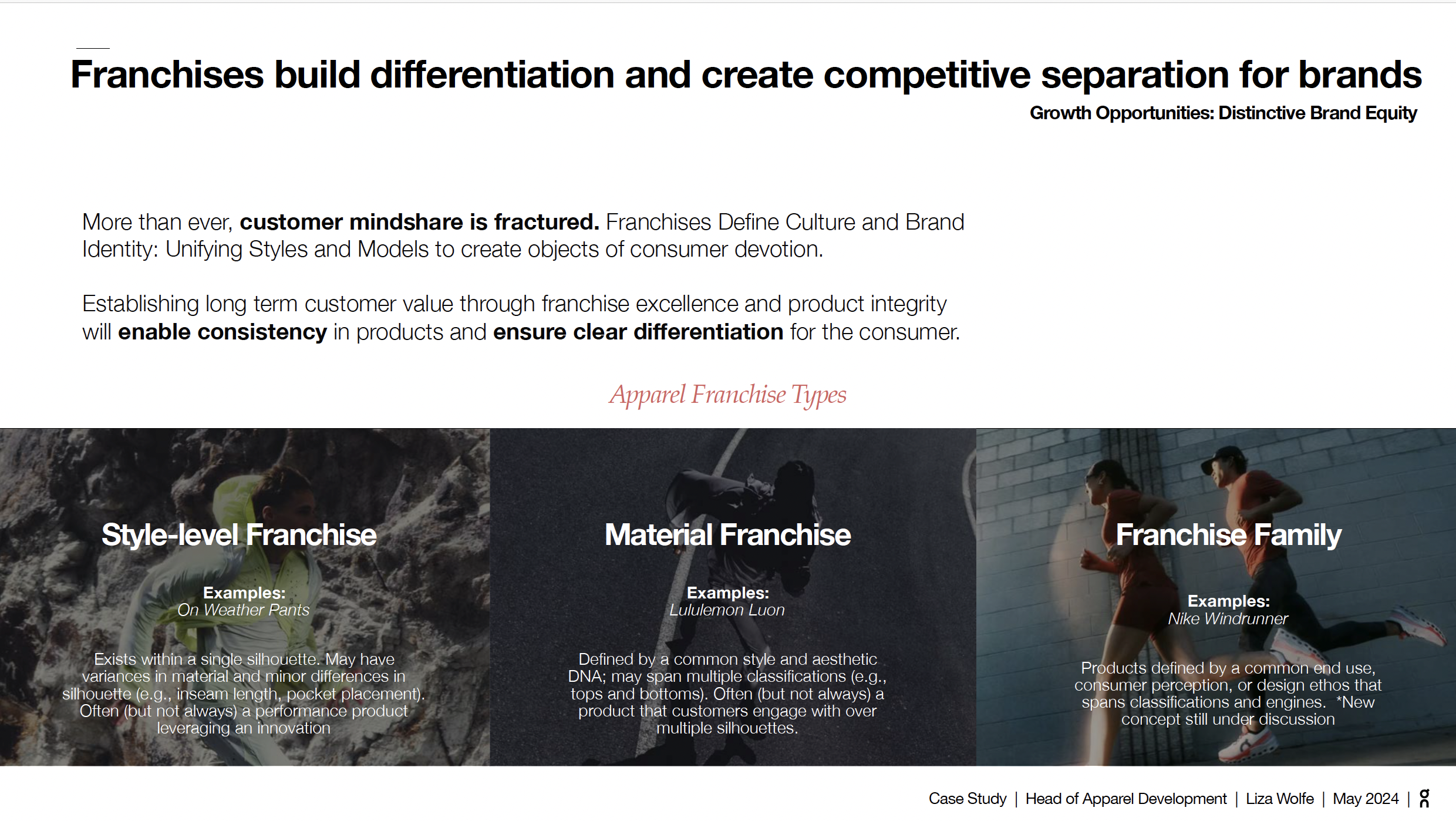
Franchise is how brand architecture becomes commercial reality.
Brand equity doesn't build itself. It gets built through products consumers return to, repurchase, and identify with over time. Franchise architecture is how that happens in apparel through style-level consistency, material innovation that spans silhouettes, and franchise families that define how a brand shows up across an entire end use. This is the mechanism that connects brand strategy to product strategy. It's also where most challenger apparel brands underinvest.
Organizational Design
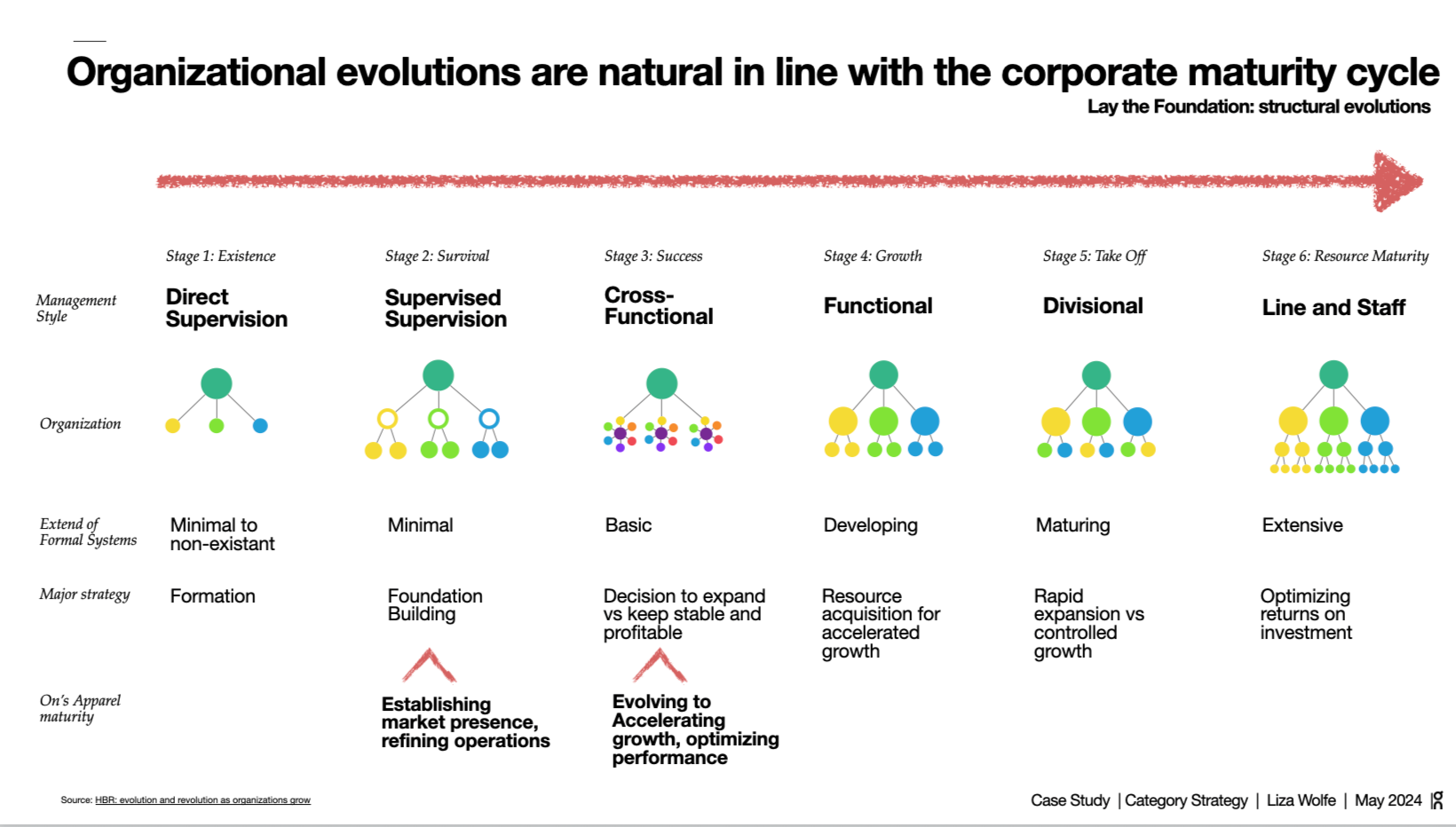
The org structure that got On's apparel business here won't get it to $5B.
That's not a criticism, it's a maturity curve.
Every organization moves through a predictable maturity cycle as it scales. On's apparel business sits between Stage 2 and Stage 3 on the HBR model, establishing market presence, refining operations, beginning to accelerate. The structural evolution required to move toward Stage 4 and beyond isn't optional and it isn't linear. It means moving from supervised supervision to cross-functional management, developing formal systems, and making deliberate resource acquisition decisions.
The product and merchandising teams, pattern engineers, 3D specialists, and fit specialists aren't headcount, they're the infrastructure that makes speed and quality coexist at scale. Building that team ahead of demand is what separates brands that scale well from brands that scale chaotically.
GROWTH SEQUENCING
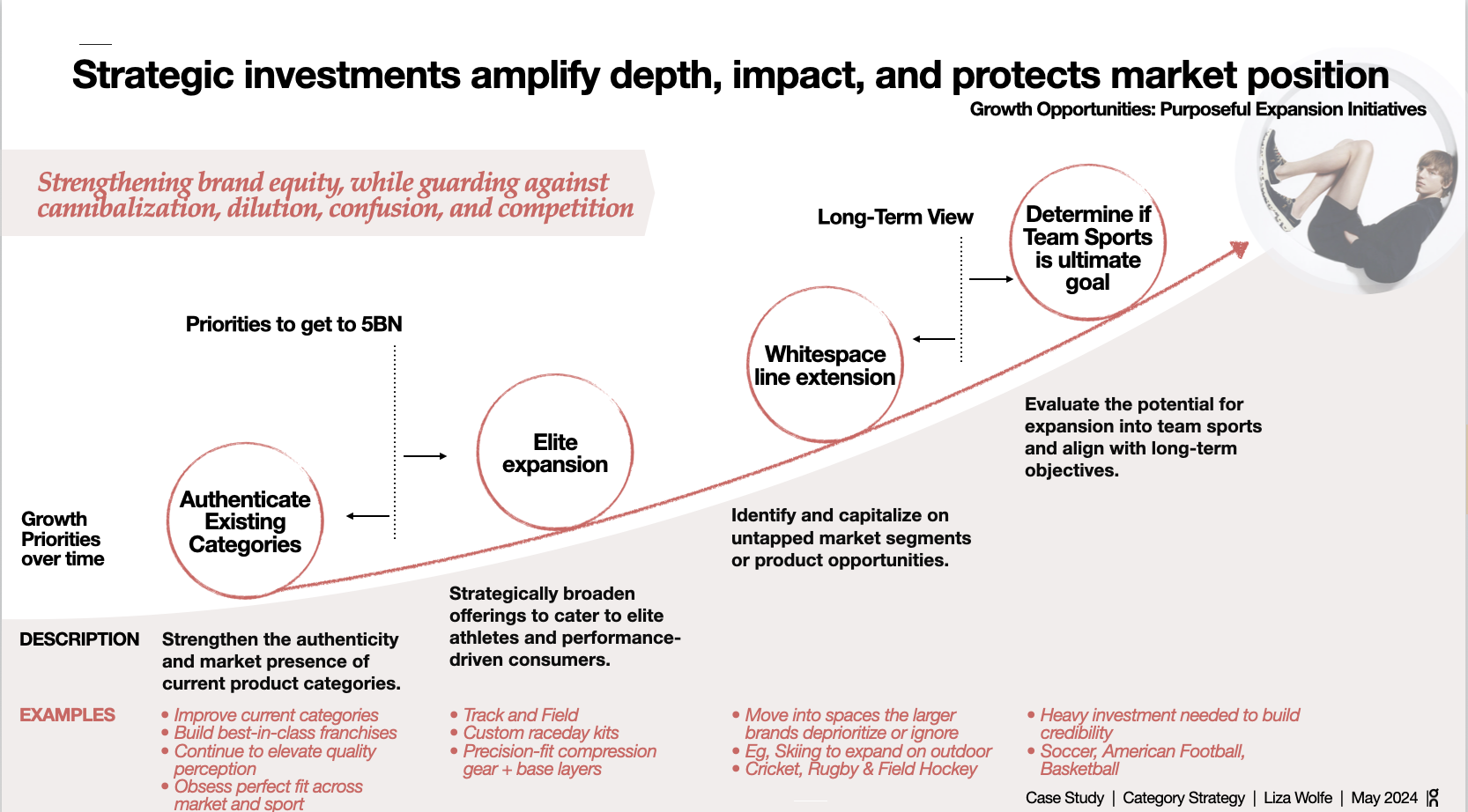
The fastest path to $5B is not the broadest one.
The instinct in a growth mandate is to expand; new categories, new consumers, new markets simultaneously. That's how brands dilute.
The strategic priority sequence here is deliberate: authenticate existing categories first, build best-in-class franchises, elevate quality perception. Then pursue elite expansion into track and field, compression, raceday. Then identify whitespace where larger brands have deprioritized or ignored that resonate with the brand’s values around premium performance and Swiss engineering.
Team sports (soccer, basketball, American football) is a long-term question that requires heavy investment to build credibility. Doing it before the foundation is solid doesn't accelerate growth. It fragments it.
SPEED AND MARGIN
Margin and speed don't trade off against each other. They both come from the same place: franchise investment.
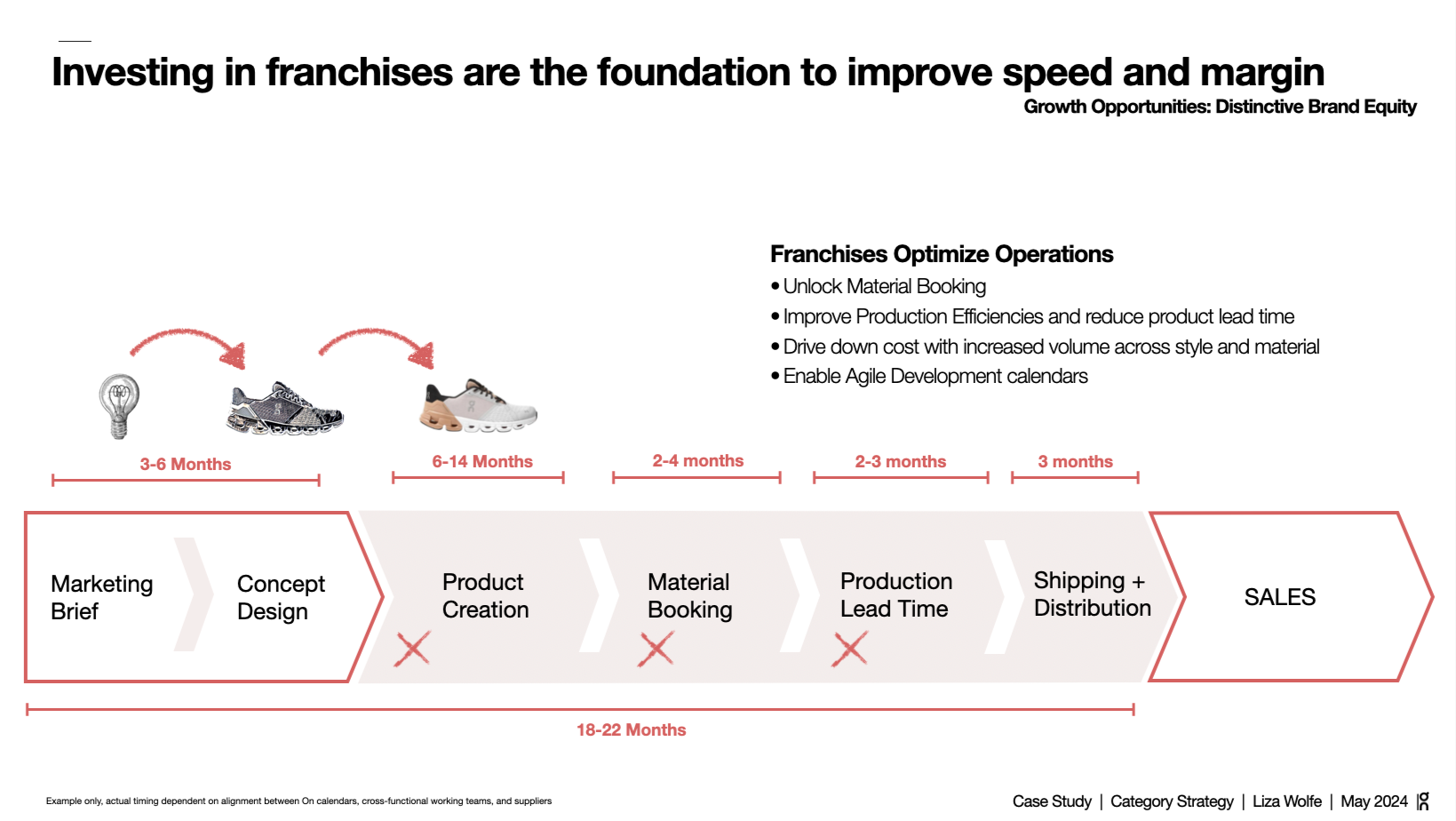
The conventional approach to improving speed is to compress production timelines. The conventional approach to improving margin is to reduce material cost. Both of those interventions happen at the wrong end of the pipeline. The front end — brief through design — is where 9 to 20 months of calendar disappears and where the most expensive creative decisions get made without commercial grounding.
Franchise architecture changes that. When construction is proven, materials are committed, and suppliers have relationship history, a new seasonal product becomes an update. That's how 18 months becomes 4 to 6 weeks. That's where the margin is.
Cross-Functional LEADERSHIP
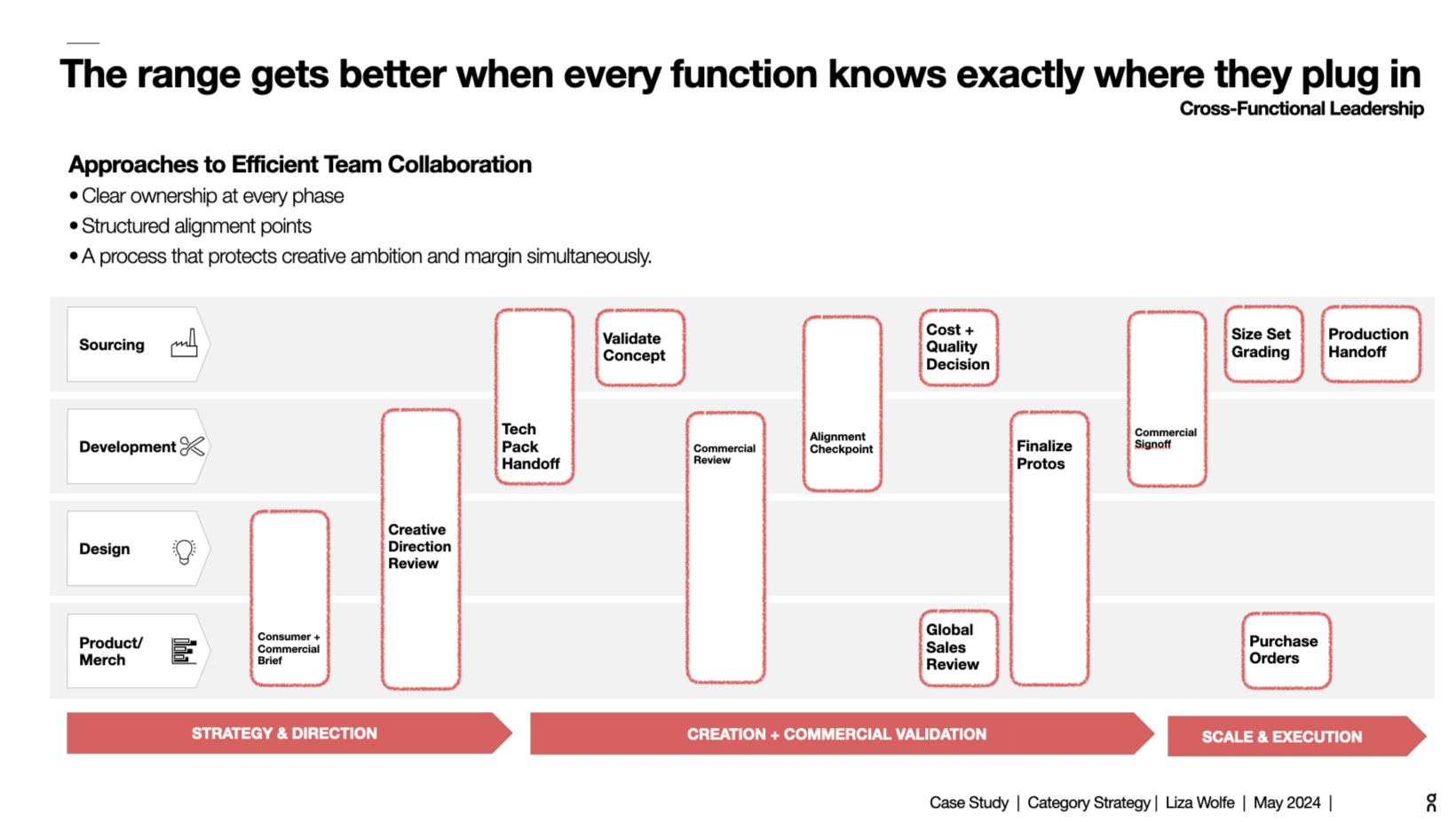
The best ranges aren't built by any one function.
They're built when every function is aligned around the same commercial outcome.
The conversations that determine whether a range succeeds happen long before production starts. Design needs to know what's feasible before committing to a creative direction. Merchandising needs technical context to make margin-informed assortment decisions. Sourcing needs standards and specifications early enough to influence cost and lead time. Development needs commercial grounding to push back on complexity that doesn't add consumer value.
When those conversations happen in sequence, each function waiting for the one before it to finish, speed slows, cost rises, and the product that reaches market is a compromise. When they happen in parallel, with shared visibility into the consumer need and the commercial target, the range gets sharper, faster, and more profitable. That's the operating model I build.